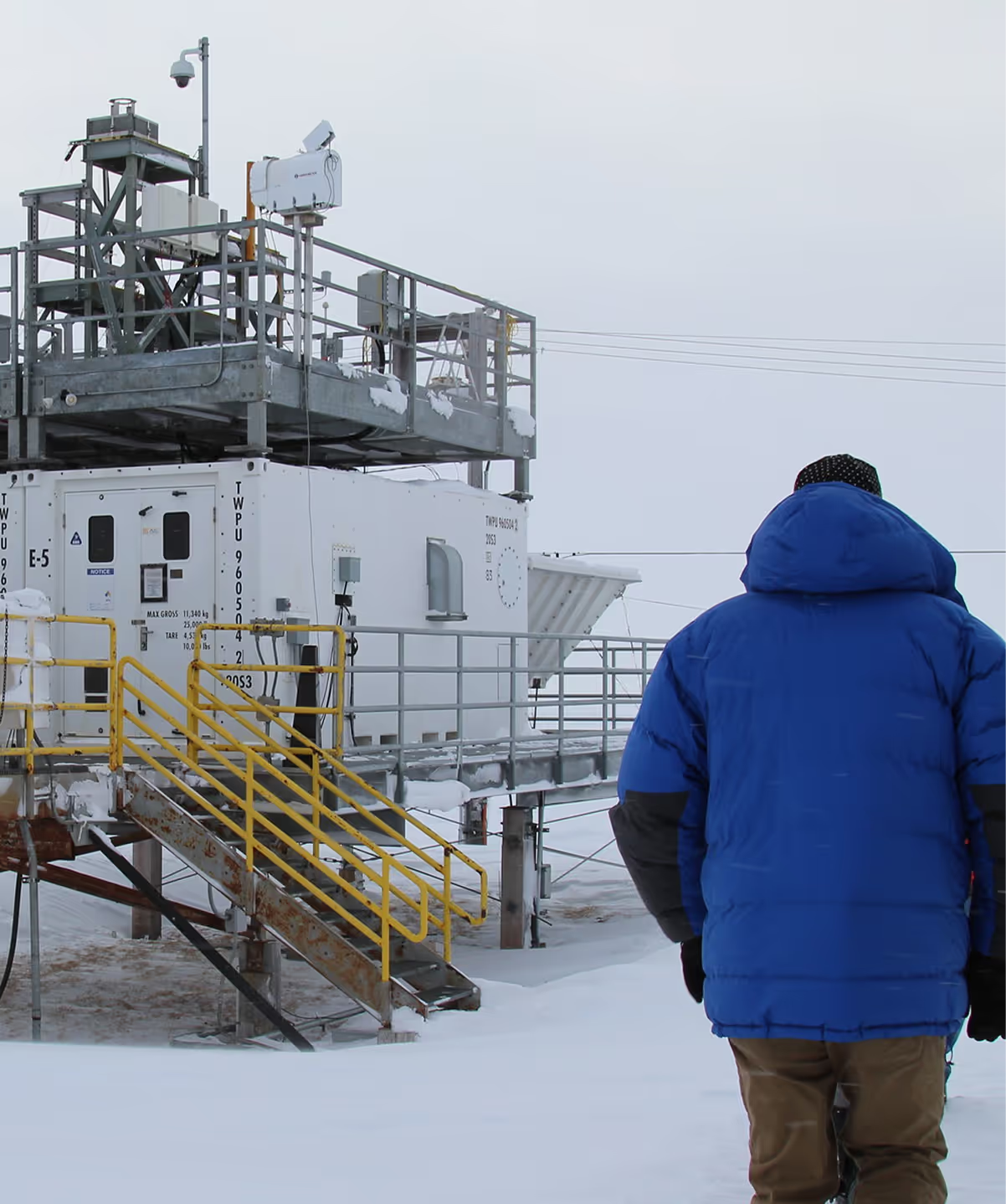

Our team
Charlotte DeWald
Charlotte DeWald is an atmospheric scientist whose expertise centers on ice-nucleating particles (INP), rare aerosols that influence cloud ice formation, precipitation, and how much heat the atmosphere holds—work that spans the biological, chemical, and physical systems linking the ocean to the atmosphere.
Her previous research resulted in observations of INP over remote oceans, patented instrumentation for detection of highly efficient INP, and observations-based constraints for Earth systems models. Charlotte builds the interdisciplinary teams and partnerships that long-standing scientific challenges require, and the capacity for translational research that keeps pace with accelerating climate risk. She holds a Ph.D. in Climate Science from Scripps Institution of Oceanography.
Ryan O'Donnell
A former U.S. diplomat and disaster response leader, Ryan spent a decade working in disaster-preparedness and response operations, as well as co-designing climate resilience initiatives with Indigenous Peoples.
He leads ASI’s engagement with Indigenous Peoples, whose lands are directly affected by Arctic climate risks, and the governments and multilateral institutions whose partnership is needed for successful initiatives.
Scientific Advisory Board
The Scientific Advisory Board is an independent group of scientists who advise on ASI's research strategy. Members bring expertise across Arctic clouds, including aerosol–cloud interactions, modeling, and observation. They help align ASI's research with the evidence each stage gate requires.
Dr. Graham Feingold
Dr. Graham Feingold is a research scientist at the National Oceanic and Atmospheric Administration's (NOAA's) Chemical Sciences Laboratory in Boulder, Colorado. He has extensive experience with aerosol, clouds, and proposed climate intervention methods that could potentially cool the planet and buy time for decarbonization efforts. He is committed to fundamental understanding of these systems and presenting findings in a way that helps decision makers reach wise decisions.

Dr. Christina McCluskey
Dr. Christina McCluskey is a scientist at the U.S. National Science Foundation (NSF) National Center for Atmospheric Research and her research focuses on aerosol and cloud microphysics with an expertise in mixed phase clouds. Her career began as an observational scientist, making measurements from ships, aircraft, and surface stations. Now, her research leverages observations to confront model representations of aerosol, cloud, and precipitation processes in polar regions.

Dr. Matthew Shupe
Dr. Matthew Shupe is a senior research scientist and Fellow at the Cooperative Institute for Research in Environmental Sciences at the University of Colorado and NOAA in Boulder. He has studied Arctic mixed-phase clouds and the Arctic system for more than 25 years, with a special focus on the changing cryosphere. His work is grounded in observations collected across the many domains of the Arctic including terrestrial land surfaces, the Greenland Ice Sheet, and the Arctic Ocean. He works closely with modelers to evaluate and improve Arctic system prediction capabilities.
Independent Oversight Committee (IOC)
Reviews stage-gate decisions and ensures our governance is followed. Operates independently of program leadership.
Want to apply, partner, or follow our work?
Whether you are a scientist, Indigenous leader, funder, or policy maker, we want to work together.