Three initiatives.
ASI’s mission is to produce the evidence needed to assess whether regionally-targeted interventions could plausibly stabilize the Arctic climate, as well as identify and engage the governments, multilateral institutions and Indigenous rights-holders this evidence serves.
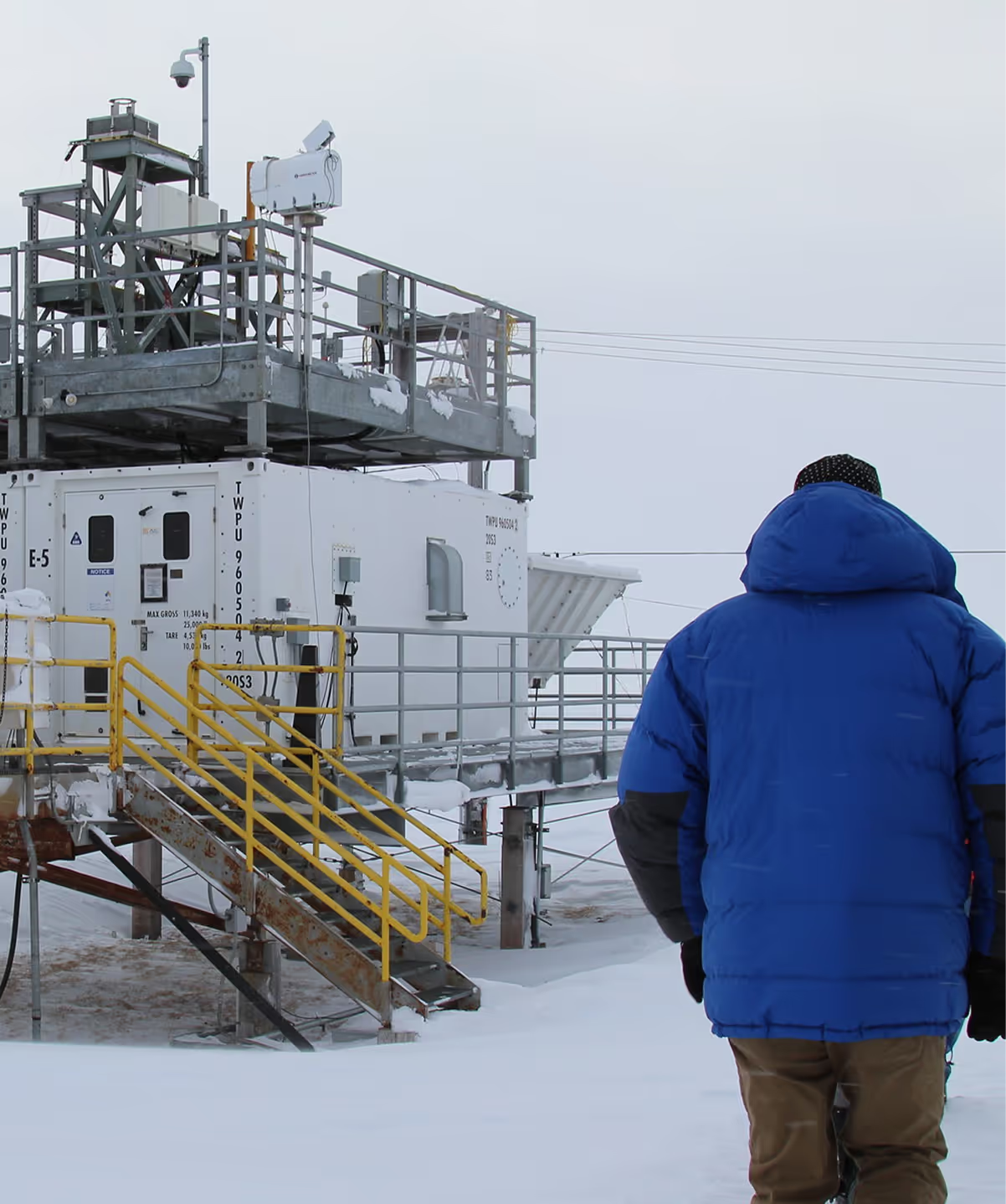
Our Scientific Assessment Initiative builds the benchmarks, models, and predictive understanding needed to evaluate MCT, our first focus, against the program's core scientific questions.
Our Pathways work prepares the public sector to judge whether targeted climate interventions warrant the institutional-scale investment required to resolve the decision-critical questions that remain. This Initiative also learns what the policymakers, Indigenous rights-holders, and the public need to know, shaping science priorities to address those needs where possible, or equipping others whose work bears on the decision to act but lies beyond our scope.
Our Indigenous Partnership initiative places Indigenous Rights Holders at the center of our work — engaging them as enduring partners and elevating their voices and perspectives into ASI's own governance and decisions. It also supports Indigenous rights and resilience directly, through our Indigenous Resilience and Rights (IRR) program, independent of our research.
01: Assess the Efficacy of Climate Interventions to Stabilize the Arctic
Our first focus: Mixed-Phase Cloud Thinning
The first intervention ASI is advancing through its stage-gated framework is Mixed-Phase Cloud Thinning (MCT).
About 60% of Arctic clouds are mixed-phase, meaning they contain both ice crystals and supercooled liquid water. In concept, MCT enhances ice formation in Arctic clouds to reduce their heat-trapping effect, allowing more heat to radiate from the surface and preventing sea ice loss.
Across proposed Arctic-targeted interventions, MCT stands out in several dimensions:
- Tractability: MCT is operationally equivalent to cloud seeding, with state and agency-supported cloud seeding programs already running across 11 U.S. states and Canada and elsewhere globally. This may lower technical, regulatory, and political barriers.
- Strategic timing: MCT may be most effective during sea-ice thickening and transition seasons, where delaying the shift from reflective ice to dark open water by even a few weeks could yield outsized cooling benefits.
- Scalability and co-benefits: Low infrastructure and resource intensity relative to other proposed interventions. Potential increases in snowfall and sea-ice reflectivity could reinforce a cooling cycle through the rest of the year.
MCT also sits at the center of one of the greatest challenges in climate science, one that is in need of increased focus. In Arctic mixed-phase clouds, small changes can have large radiative impacts, and existing models struggle to represent many of the essential physical processes. Observational data to better constrain these processes is scarce. Evaluation of MCT requires a carefully staged integration of natural experiments, targeted observations, and multi-scale modeling, which ASI is designed to support.
02: Indigenous Partnership
For millennia, the Arctic has been home to Indigenous Peoples — more than 40 distinct nations across the circumpolar North. ASI is committed to partnering with them substantively and consistently within our research, and to supporting their rights and resilience through efforts that stand entirely apart from it. We act on that commitment in three ways:
- Engaging Indigenous governments, organizations, and communities early and throughout the program;
- Integrating Indigenous expertise into ASI's staffing, governance, scientific work, and decision-making, so that Indigenous knowledge shapes our work from within;
- Providing standalone support - independent of ASI's research - through ASI’s Indigenous Rights and Resilience (IRR) programming, including a $1 million commitment to deliver resilience and adaptation support to Indigenous communities and under-resourced Indigenous organizations.
03: Pathways to Public-Sector Action
Pathways identifies who would use the evidence generated from our program, builds the routes to reach them, learning what decisions they face and what evidence would support them.The decision to act on what we find rests with the public institutions, multilateral bodies, and Indigenous Rights Holders our work is meant to serve. Our role is to give them a rigorous, independent determination of the safety, efficacy, and feasibility of the interventions that could potentially save the lives, livelihoods, and infrastructure of millions based on the strongest possible evidence.
Three initiatives, one mission

Science

Partnership

Handoff
Want to apply, partner, or follow our work?
Whether you are a scientist, Indigenous leader, funder, or policy maker, we want to work together.